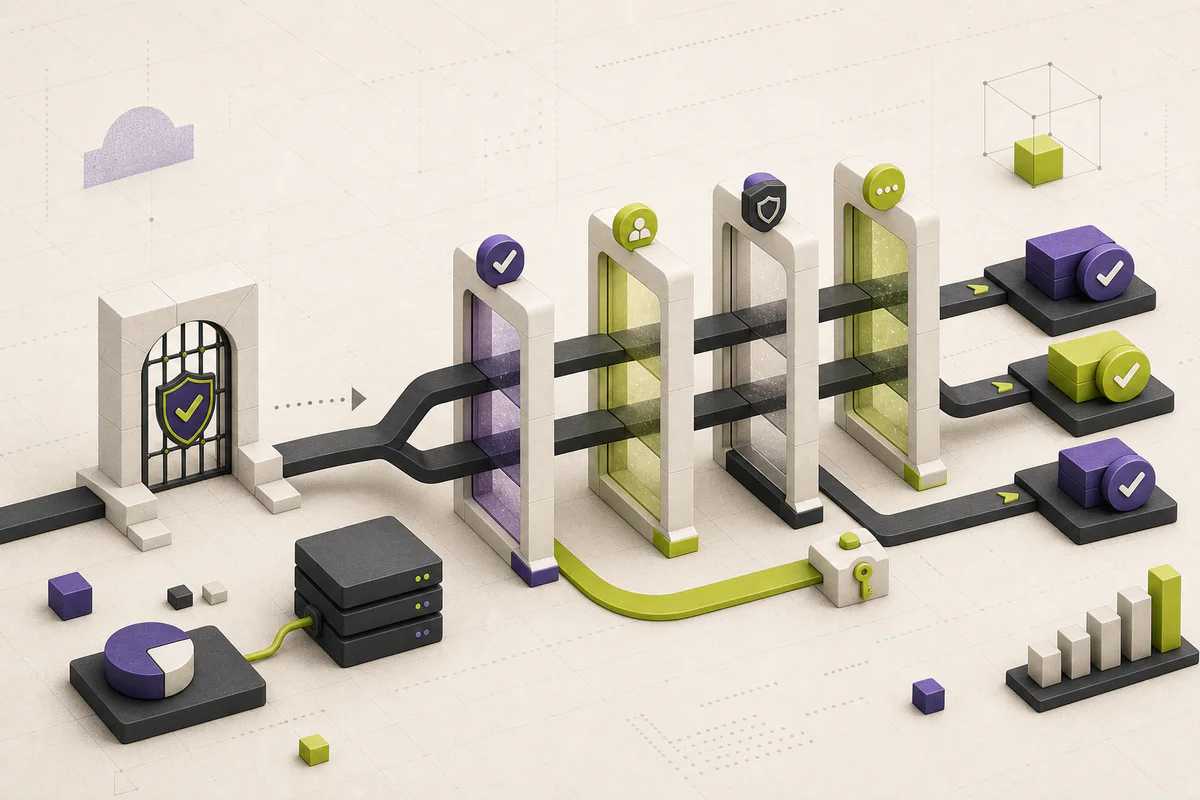
Prioritize updates that change defaults, permissions, pricing, or interoperability.
Update — August 13, 2026: The filter now separates applicability from urgency, gives exploited vulnerabilities their own security path, and adds a closure record for testing, rollout, rollback, and exceptions.
Software companies announce changes constantly. Following all of them is impossible, and trying usually creates more distraction than insight.
A simple filter can identify the small number of updates that deserve investigation.
The four signals
Open the full announcement when a change affects one of these areas. Security updates add a fifth question: is the vulnerability known to be exploited? CISA’s Known Exploited Vulnerabilities catalog exists to distinguish evidence of exploitation from a severity score alone.
NIST frames patching as preventive maintenance: identify, prioritize, acquire, install, and verify updates through an operational strategy. That is more useful than treating every release as an emergency or leaving every update to chance.
- A default setting changes without user action
- Data access or administrator permissions expand
- A feature moves between pricing tiers
- An integration, file format, or API changes
Check applicability before declaring urgency
A severe or widely discussed update may not affect the organization’s edition, version, region, configuration, or exposed assets. Record the affected product and version, deployment model, release channel, prerequisite, effective date, default state, and named user group. Mark unknowns explicitly and assign someone to resolve them.
Then estimate consequence and time pressure. A permission expansion enabled by default may require action before rollout. A price increase matters before the notice or renewal deadline. An API retirement needs enough lead time to inventory consumers and test replacements. Applicability answers “is this ours?”; urgency answers “when does a decision become expensive?”
Give exploited vulnerabilities a separate path
For a security bulletin, record the vulnerability identifier, affected versions, known exploitation status, asset exposure, privilege required, available fix or mitigation, and evidence that the control was applied. CISA’s Known Exploited Vulnerabilities catalog is evidence that exploitation has occurred in the wild; it does not replace checking whether the affected product exists in your environment.
Prioritize the combination of exploitation, exposure, business impact, and available remediation. A high severity score alone is not a complete deployment order, and a low-profile exploited flaw on an internet-facing asset should not wait behind a cosmetic feature release.
- Confirm the asset and version are affected.
- Check exposure and compensating controls.
- Choose update, mitigation, isolation, or documented exception.
- Verify the version or control after deployment and monitor for failure.
Match the response to the signal
Confirm the change in primary documentation, record the effective date, identify affected versions and workflows, and assign a single owner. A known-exploited vulnerability on an internet-facing system deserves a different timeline from a redesigned button.
For defaults and permissions, capture the current state before rollout and test with a limited group. For pricing, calculate the annual effect and cancellation deadline. For APIs and integrations, run contract tests and monitor failures. For retirements, inventory remaining users and dependencies before choosing a migration date.
Verify completion, not installation
An update is complete when the target version is present, the service is healthy, the affected workflow works, and monitoring shows no new error pattern. Keep rollback instructions for changes that can disrupt production, and record exceptions with an owner and expiration date.
Most updates need awareness, not a meeting. The ones that change exposure, access, cost, or interoperability need an explicit decision and proof that the decision was carried out.
- Identify affected assets and users.
- Prioritize using exploitation, exposure, and business impact.
- Test or stage when the risk of disruption warrants it.
- Deploy with a rollback path.
- Verify the result and close documented exceptions.
Keep a one-record decision trail
For every update that passes the filter, retain the primary source, applicability decision, affected assets or users, owner, deadline, test, chosen response, rollback condition, verification evidence, and unresolved exceptions. This can live in an existing ticket system; it does not require another platform.
Close “note” items after the affected audience is informed. Close “test” items after the expected workflow is observed. Close “act” items after the new state is verified. Give exceptions an owner and expiry date so postponement does not become an undocumented permanent decision.
This article explains the practical implications of the primary material below. PatchMemo does not publish vendor copy as editorial coverage and does not accept payment for positive coverage.
PatchMemo independently selects and evaluates the topics it covers. Analysis and recommendations are ours; sources are linked so readers can check the underlying claims. We clearly label sponsorships and affiliate relationships, and neither determines coverage or conclusions.